
Which Shopify Plan Do You Actually Need?
 John Dwyer 10 min read
 A guide for anyone exploring Shopify, grouped by the considerations that actually drive the decision. All pricing is AUD, with yearly billing rates shown. Shopify says yearly billing saves up to 25%; if you pay monthly, the public prices shown are higher: Basic $56/mo, Grow $149/mo, and Advanced $575/mo.
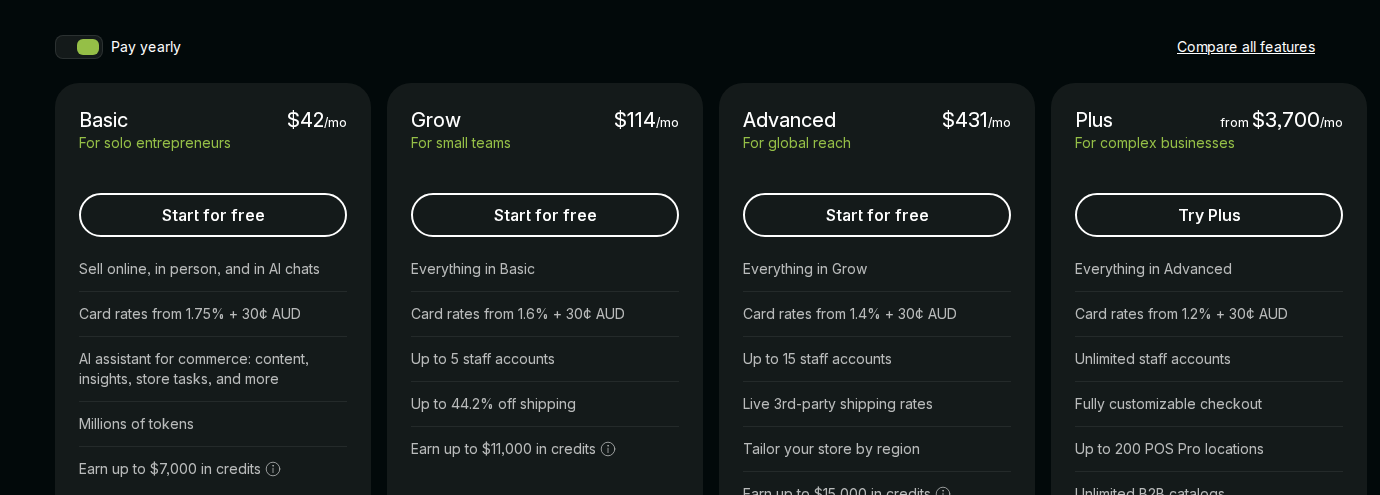
The four full-store plans: Basic $42/mo, Grow $114/mo, Advanced $431/mo, Plus from $3,700/mo.
This guide compares Shopify’s full online store plans. It does not cover Shopify Starter or Agentic plans, which are for different use cases.
The core platform is the same across all of them. Every plan gets a full-featured online store, unlimited products, checkout, social and marketplace selling, inventory management, email and SMS campaigns, marketing automation, abandoned cart recovery, and 200+ reports. What you’re actually paying for as you move up is three things: lower payment rates, more staff seats, and more control.
Quick answer: which Shopify plan should you choose?
| Plan | Choose it when |
|---|---|
| Basic | You’re solo, early-stage, using Shopify Payments, and do not need staff accounts, advanced shipping, B2B complexity or custom integrations. |
| Grow | You need staff accounts, fuller integration access, or payment-rate savings once revenue justifies it. |
| Advanced | Revenue, live carrier shipping, more staff, regional control or higher-volume operations make the jump worthwhile. |
| Plus | You hit capability walls: checkout control, serious B2B, expansion stores, POS scale, higher API limits or contract-level support. |
1. Revenue: Shopify Payments rates
Card rates drop as you go up: 1.75% + 30¢ on Basic, 1.6% on Grow, 1.4% on Advanced, and sales-led Plus rates. Shopify’s public pricing card lists Plus rates from 1.2% + 30¢ AUD, but Plus pricing and rates should be confirmed with Shopify.
So at some revenue point, the rate saving alone covers the higher subscription.
| Upgrade | Approximate monthly card sales where the fee saving covers the plan jump |
|---|---|
| Basic to Grow | $48k/month |
| Grow to Advanced | $160k/month |
| Advanced to Plus | Over $1.6M/month on Shopify’s public Plus rate example |
Rule of thumb: rates can justify Grow and Advanced. They rarely justify Plus by themselves.
2. External payment providers
If you use a third-party gateway instead of Shopify Payments, Shopify adds a fee on top of whatever your gateway charges: 2% on Basic, 1% on Grow, 0.6% on Advanced, 0.2% on Plus.
This changes the maths completely. A store locked into an external provider, such as specific merchant facilities or gateways required by a bank or franchise agreement, should upgrade much earlier. The Basic-to-Grow jump saves a full 1% of revenue, which covers the price difference at just $7,200/month in sales. Grow to Advanced saves 0.4%, breaking even around $80k/month.
If you can use Shopify Payments, do. If you can’t, factor the surcharge into your plan choice from day one.
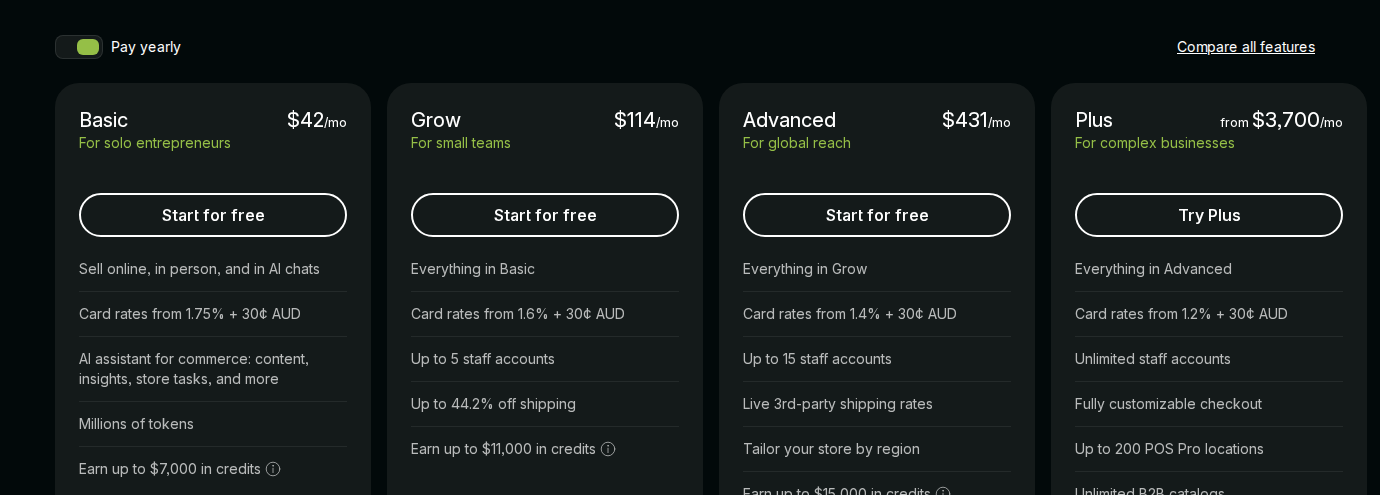
Source: Shopify AU pricing, card-rate and third-party transaction fee rows.
3. Team size
- Basic: no additional staff accounts. You can invite third-party collaborators, so agencies and freelancers don’t need a seat.
- Grow: 5 staff accounts.
- Advanced: 15 staff accounts.
- Plus: unlimited, plus custom user groups and permissions.
This is the most common real-world upgrade trigger. The moment you hire someone who needs admin access, Basic is done, regardless of revenue. Grow to Advanced follows the same logic at employee six. Plus matters here only if you’re past 15 admin users or need granular permission control.
4. Shipping
- Basic: flat and weight-based rates only. No live carrier rates.
- Grow: live third-party calculated rates available as a paid add-on.
- Advanced and Plus: live carrier rates included.
If you ship bulky, heavy, or freight items where flat rates lose you money on every second order, this becomes the deciding factor. Price the Grow add-on against the Advanced upgrade before jumping, because if you’re nowhere near the revenue threshold, the add-on is usually cheaper. Shipping label discounts, up to 44.2% off, are identical on every plan, so that’s never a reason to upgrade.
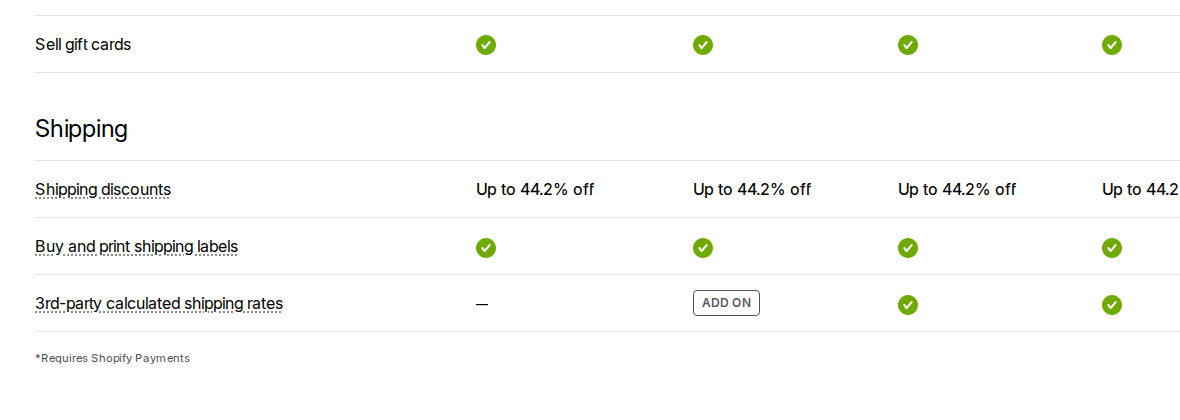
Source: Shopify AU pricing, compare-all-features table.
5. B2B and wholesale
Basic, Grow, and Advanced all cap you at 3 B2B catalogs. Plus gives you unlimited.
Three catalogs is enough for a simple trade tier or two alongside retail. If you’re a genuine wholesale operation with customer-specific pricing across many accounts, this is a hard wall and one of the strongest legitimate reasons to buy Plus.
6. Checkout control
Checkout customisation is limited on Basic, Grow, and Advanced. Only Plus gives full checkout customisation, custom functions, and high-volume checkout.
If your conversion strategy involves modifying the checkout itself, such as custom fields, upsells in checkout, branded checkout experiences or custom discount logic, no amount of revenue on a lower plan gets you there. This is a Plus-only capability and probably its single biggest selling point.
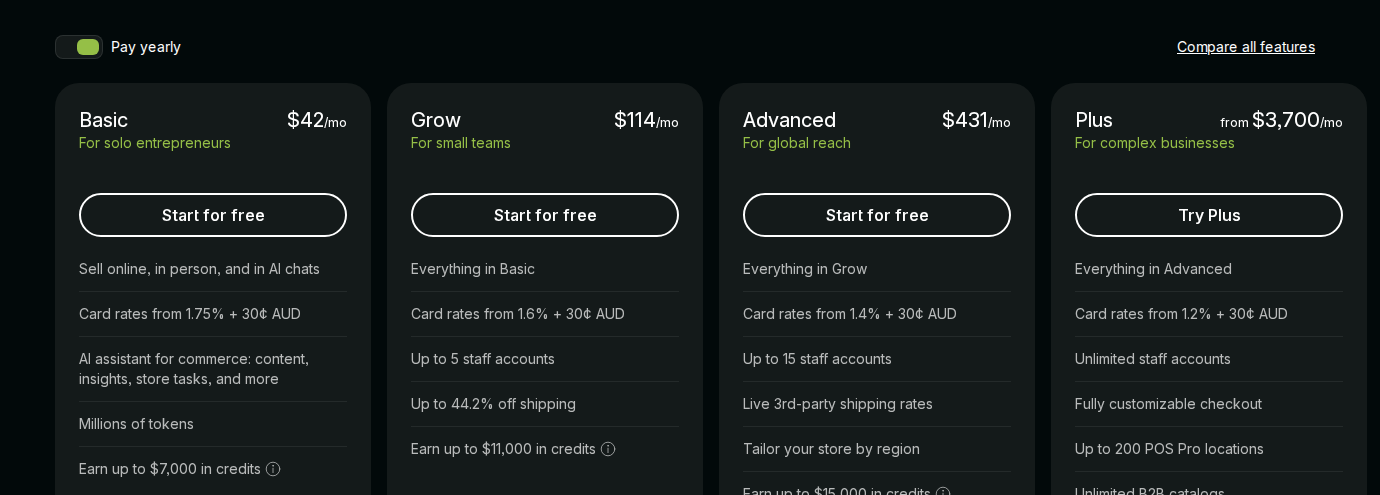
Source: Shopify AU pricing, staff account, checkout and Plus feature rows.
7. ERP, integrations and APIs
- Basic: limited data access for custom apps.
- Grow and Advanced: full data access. Advanced adds up to 2x rate limits on select APIs.
- Plus: up to 10x rate limits and 25 headless storefronts, versus 1 elsewhere.
If you’re connecting an ERP like MYOB Advanced, Cin7 or Unleashed, syncing large catalogues, or building custom middleware, Basic’s limited API access rules it out immediately. Grow handles most integration work fine. High-volume syncs, such as thousands of SKUs updating frequently or real-time inventory across systems, are where Advanced’s and Plus’s rate limits start to matter.
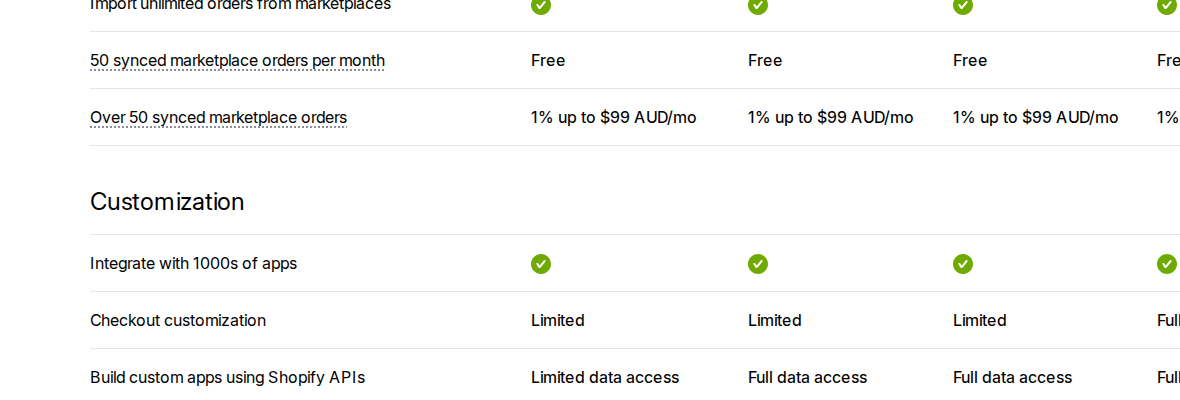
Sources: Shopify AU pricing and Shopify Help plan features.
8. International and multi-store
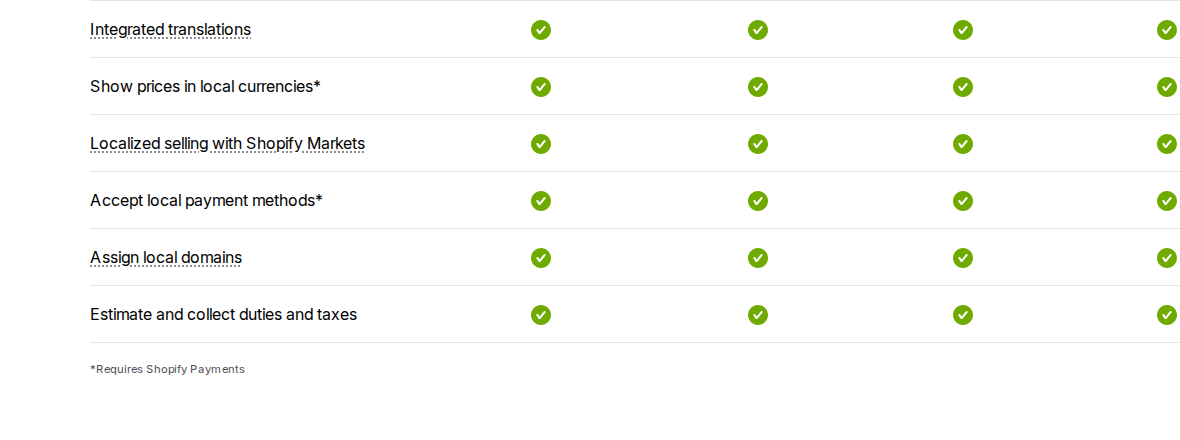
Every plan includes Shopify Markets, translations, local currencies, and duties collection. Advanced adds the ability to tailor your store by region. Plus adds up to 9 free expansion stores.
Selling internationally from one store works on any plan. Serious regional differentiation nudges you to Advanced. Running genuinely separate storefronts, such as different brands or full local stores per market, is where Plus’s expansion stores beat paying for multiple Advanced plans. Two Advanced plans cost $862/month; at three or four stores the Plus maths starts getting interesting when combined with the other Plus benefits.
Sources: Shopify AU pricing and Shopify international pricing.
9. Physical retail
Casual in-person selling is included on every plan. POS Pro is $129/mo per location on Basic through Advanced. Plus includes 20 locations, or 200 with Shopify Payments.
The crossover: at roughly 25+ retail locations, Plus’s included POS Pro alone covers most of its subscription cost. Under a handful of stores, the add-on on a lower plan is fine. Inventory locations also jump from 10 to 200 on Plus, which matters for multi-warehouse or many-store operations.
Sources: Shopify AU pricing and Shopify POS pricing.
10. Support
Basic and Grow get 24/7 live chat. Advanced gets enhanced live chat. Plus gets priority 24/7 phone support.
Nobody should upgrade for support alone, but for a business where an hour of downtime costs real money, Plus’s phone support is part of the value case.
11. Commitment and billing
Basic, Grow, and Advanced can be cancelled anytime, and yearly billing saves up to 25%. Plus runs on 1- or 3-year terms you can only exit when the term expires. Shopify Plus pricing is also term-sensitive: Shopify lists $4,000/mo for a 1-year term and $3,700/mo for a 3-year term.
Practical advice: pay monthly while validating, switch to yearly once the store is proven. And treat Plus as a contract decision, not a plan change.
Common questions about Shopify plans
How much does Shopify cost in Australia?
For the full online store plans, Shopify AU lists Basic from $42/mo, Grow from $114/mo, Advanced from $431/mo and Plus from $3,700/mo on yearly or longer-term pricing. Monthly billing is higher on the public Basic, Grow and Advanced plan cards.
Which Shopify plan should I choose?
Choose based on the constraint that actually changes your business: staff accounts, payment rates, third-party transaction fees, shipping, B2B, checkout control, integrations, international stores or POS scale. Basic is usually enough for a solo early store. Grow suits small teams and standard integrations. Advanced suits higher-revenue or more operationally complex stores. Plus is for capability walls.
Is Shopify Plus worth it?
Shopify Plus is rarely justified by payment-rate savings alone. It usually becomes worth considering when you need Plus-only capabilities: checkout customisation, unlimited B2B catalogs, expansion stores, larger POS scale, higher API limits, custom user groups or priority support.
Can I start on Basic and upgrade later?
Yes. For most stores, starting on Basic or Grow while validating is sensible. Upgrade when revenue, staff access, integration limits or operational needs make the next plan cheaper or safer than staying where you are.
The pattern across all of this: Grow is triggered by team and integrations. Advanced is triggered by revenue and shipping. Plus is triggered by capability walls: checkout, B2B, expansion stores, POS scale. Fees justify the first two upgrades. They rarely justify the third by themselves.
Pricing sourced from Shopify AU pricing, Shopify Help plan features, Shopify Plus pricing, and Shopify POS pricing, checked July 2026.
A quick heads-up
We use privacy-friendly analytics to see how people enjoy the site. We don't track who you are or your identity. Privacy Policy